

Magnets work because of electrons. In simple terms, every electron behaves like a tiny magnet, thanks to an intrinsic property called electron spin. In most materials, those tiny magnets point in random directions and cancel out. In a few materials, such as iron, nickel, and cobalt, huge numbers of electrons line up and point the same way. Their small magnetic effects add together into one strong magnetic field you can feel when a magnet snaps onto your fridge. Magnetism is this collective behavior of countless atoms, scaled up from the atomic level to an object you can hold.
That magnetic field reaches out into the space around the magnet. It is invisible, yet it can move things without touching them. The magnetic force pulls on certain metals and pushes or pulls on other magnets, depending on which ends face each other. Below, we explain how that happens step by step, what makes some magnets permanent and others temporary, and how you can see it all with a few simple home experiments.
It starts with the electron
Everything around you is made of atoms, and atoms contain electrons. Electrons have an electric charge, and they have a built-in property that physicists call spin. Spin is a quantum effect, so the name is a little misleading: the electron is not literally a spinning ball. But it does give every electron a small magnetic moment, which means each electron acts like a microscopic bar magnet with its own north and south end.
Electrons also create magnetism as they orbit the nucleus, but in solid materials spin is the main source of strong magnetism. The full explanation comes from quantum mechanics, a branch of physics that describes how particles behave at very small scales. In a well-known 1983 BBC interview, the physicist Richard Feynman declined to explain magnetic attraction with an everyday analogy, because every familiar comparison would be less accurate than the real answer. The explanation above is about as close as you can get without the math.
Why most things are not magnetic
In most atoms, electrons come in pairs with opposite spins. One points “up,” the other points “down,” and their magnetic effects cancel. Wood, plastic, water, and your body have almost no overall magnetism for this reason. Some substances, such as liquid oxygen, are weakly attracted to strong magnetic fields, but the pull is far too faint to notice in daily life.
Some atoms have unpaired electrons, so each atom acts like a tiny magnet. Even then, the atoms usually point in random directions and cancel each other out on a large scale. Only in a special group of materials do the atoms cooperate.
Ferromagnetic materials: iron, nickel, cobalt
Materials that can become strongly magnetic are called ferromagnetic, from the Latin word for iron. The main ferromagnetic elements are iron, nickel, cobalt, and a few rare earth metals such as gadolinium. Many alloys, including steel, are ferromagnetic too.
In these magnetic materials, a quantum effect between neighboring atoms makes it energetically favorable for their unpaired electron spins to align, pointing in the same direction. That is the key difference. It is why a paper clip jumps to a magnet but an aluminum can does not.
Magnetic domains: small teams of aligned atoms
Even in a piece of iron, the atoms do not all point one way. The metal is divided into tiny regions called magnetic domains. Within each domain, billions of atoms have their magnetic moments aligned. But neighboring domains point in different directions, so an ordinary iron nail shows little or no overall magnetism.
When you bring a strong external magnetic field close, domains that point in the same direction as the magnet’s field grow, and the others shrink or rotate. Suddenly most of the nail points one way, and the nail becomes a magnet itself. Take the magnet away and, in soft iron, the domains drift back toward random directions. In a permanent magnet, they stay locked in place.
If you want a more detailed physics treatment of domains, the open textbook chapter on ferromagnets and electromagnets from Michigan State University is a clear next step.
Poles and magnetic field lines
Every magnet has two ends called poles, north and south. The rule is simple:
- Opposite poles attract: north pulls on south.
- Like poles repel: north pushes away north, and south pushes away south.
Try pushing two magnets together with matching ends facing each other and you will feel the repulsion clearly. Flip one around and the attraction snaps them together. This is the same force at work, just pointing the other way.
You cannot get a single pole on its own. If you cut a bar magnet in half, you do not get a separate north piece and south piece. You get two smaller magnets, each with its own north and south pole. This keeps happening no matter how small you cut, all the way down to single atoms.
The region around a magnet where its force can be felt is called the magnetic field. Scientists draw it with field lines. The lines leave the north pole, curve around through the air, and enter the south pole. Where the lines are close together, near the poles, the field is strongest. Where they spread out, it is weaker. The field fades quickly with distance, which is why a magnet can grab a paper clip from a centimeter away but not from across the room.
Magnetic field strength is measured in tesla. A typical fridge magnet produces around 5 millitesla at its surface, roughly 100 times stronger than Earth’s field.
Types of magnets
Permanent magnets
Permanent magnets keep their magnetism without any outside help. Their domains stay aligned because the material resists changes, a property called coercivity. Common types include:
- Ferrite (ceramic) magnets: cheap, dark gray, and brittle. Used in fridge magnets, speakers, and many toys.
- Alnico magnets: made of aluminum, nickel, and cobalt with iron. They handle heat well and are used in guitar pickups and sensors.
- Samarium-cobalt magnets: strong, heat-resistant, and expensive.
- Neodymium magnets: the strongest permanent magnets commonly available.
Neodymium magnets
Neodymium magnets are made from an alloy of neodymium, iron, and boron (NdFeB). They were developed in the early 1980s and are now found in phones, earbuds, hard drives, cordless tools, electric car motors, and wind turbines. A neodymium magnet the size of a coin can hold many times its own weight.
That strength comes with a few cautions. Two large neodymium magnets can slam together hard enough to pinch skin or shatter, and swallowed magnets can attract each other through the walls of the intestines and cause serious injury.
Temporary magnets
A temporary magnet acts like a magnet only while it is near a strong magnetic field. A steel paper clip hanging from a magnet can pick up a second paper clip, and that one can pick up a third. Pull the magnet away and the chain falls apart. Soft iron is the classic temporary magnet because its domains line up easily and let go easily.
Electromagnets
Moving electric charges create magnetic fields. Run an electric current through a coil of wire and the coil becomes a magnet. Wrap that coil around an iron core and the field gets much stronger, because the iron’s domains line up with it. This is an electromagnet.
The big advantage is control. You can switch an electromagnet on and off, make it stronger with more current or more turns of wire, and flip its poles by reversing the current. Scrapyard cranes use huge electromagnets to lift cars and drop them on command. Electromagnets show that electricity and magnetism are two sides of one force, electromagnetism. Physicists in the 1800s, most famously James Clerk Maxwell, managed to unify them in a single set of equations.
| Type | How it stays magnetic | Can you switch it off? | Typical uses |
|---|---|---|---|
| Permanent magnet | Domains locked in place | No | Fridge magnets, speakers, motors, compasses |
| Temporary magnet | Only while near another magnet | Yes, by removing the magnet | Paper clips, nails, iron cores |
| Electromagnet | Electric current in a coil | Yes, by cutting the current | Cranes, MRI scanners, doorbells, relays |
Why magnets lose strength
Permanent magnets are stable, but not forever and not under all conditions. Their domains can be knocked out of alignment in several ways.
Heat and the Curie point
Heat makes atoms jiggle. The hotter a magnet gets, the harder it is for its electron spins to stay lined up. Above a certain temperature, called the Curie temperature or Curie point, a ferromagnetic material loses its magnetism completely. For iron, that is about 770°C (1,418°F). For nickel, it is about 358°C.
Many magnets start losing strength well below their Curie point. A standard grade neodymium magnet has a Curie temperature of around 310°C but can lose strength permanently if heated above about 80°C (176°F). That is why electric motors in cars use special heat-resistant grades.
Other causes
- Strong opposing fields: placing a magnet in strong magnetic fields that oppose its own can flip or scramble its domains. A magnet treated this way is said to be demagnetized.
- Hard knocks: dropping or hammering some older magnet types can jostle domains out of line.
- Corrosion: neodymium magnets rust easily, which is why they are usually coated with nickel.
- Time: modern permanent magnets lose only a tiny fraction of their strength over many years at room temperature.
Earth is a giant magnet
Earth has its own magnetic field, and it comes from deep underground. The planet’s outer core is made of molten iron and nickel. As this liquid metal churns and flows, it produces electric currents, and those currents create a magnetic field. Scientists call this process the geodynamo.
At the surface, Earth’s field is weak, between about 25 and 65 microtesla depending on where you stand. But it reaches far into space and helps deflect charged particles from the Sun. When some of those particles slip in near the poles, they light up the sky as auroras.
A compass needle is a small magnet that lines up with Earth’s field. Here is a fun twist: the end of the needle marked “north” is attracted to the north magnetic pole. Since opposites attract, the magnetic pole in the Arctic is, in physics terms, actually a south magnetic pole. Earth’s magnetic poles also wander over time, and the field has flipped direction many times over the planet’s history.
Can we live without magnets? Everyday uses
Modern life would look very different without them. Magnets are hidden inside most machines that move or make sound.
- Electric motors: magnets and electromagnets push against each other to turn a shaft. Fans, washing machines, drills, and electric cars all depend on this.
- Generators: the reverse of a motor. Spinning a magnet near a coil of wire produces electric current. Most of the world’s electricity is made this way.
- Speakers and headphones: an electromagnet attached to a cone moves back and forth against a permanent magnet as the audio signal changes, pushing air to make sound.
- MRI scanners: hospital MRI machines use powerful electromagnets, usually 1.5 or 3 tesla, to create detailed images of the inside of the body.
- Fridge doors and fridge magnets: the rubber door seal contains a flexible magnetic strip that keeps the door closed.
- Data storage: hard drives record information as tiny magnetized regions on a spinning disk.
- Credit cards, sensors, and compasses: many everyday devices read or respond to magnetic fields.
Where should you not put magnets?
Most magnets are harmless, but strong ones need a little care. Keep them away from:
- Pacemakers and other implanted medical devices
- Credit cards with magnetic stripes, older hard drives, and mechanical watches
- Young children and pets, who might swallow small magnets
- Hot places such as stovetops, car dashboards in summer, or ovens, which can weaken them
- Other strong magnets, since a stack of neodymium magnets can be very hard to pull apart and can pinch fingers
Simple home experiments
You do not need a lab to see magnetism at work. These experiments work well with kids and use everyday materials. Adults should supervise, and small or neodymium magnets should be kept away from young children.
1. Sort magnetic and nonmagnetic objects
Gather a fridge magnet and a pile of objects: a coin, a paper clip, aluminum foil, a spoon, a key, a plastic cap. Predict which will stick, then test each one. You will find that iron and steel stick, while aluminum, copper, and plastic do not. Many coins in the US are not magnetic at all.
2. Make a temporary magnet
Stroke a steel sewing needle or nail about 30 times in the same direction with one end of a magnet. Lift the magnet away at the end of each stroke. Now see if the needle can pick up a paper clip or small pin. You have lined up its domains. Drop it a few times and watch the effect fade.
3. Build a compass
Magnetize a needle as above, push it through a small piece of cork or lay it on a floating leaf, and set it in a bowl of water. It will slowly turn to point north and south. Compare it with a phone compass app.
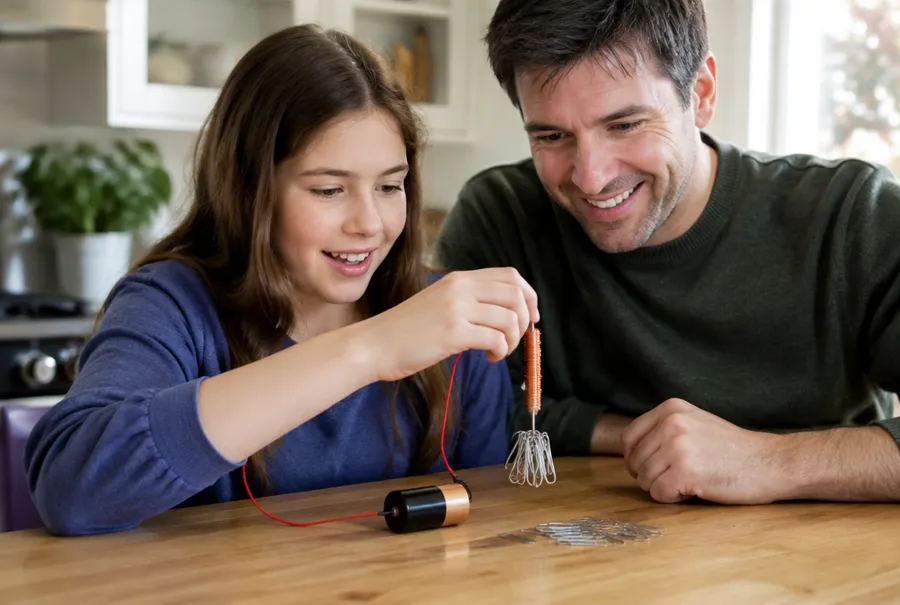
4. Build an electromagnet
Wrap insulated copper wire tightly around an iron nail, leaving the ends free. Connect the ends briefly to a D-cell battery. The nail will pick up paper clips. Add more turns of wire and it gets stronger. Disconnect the battery and the clips fall. Do not leave it connected for long, since the wire and battery can get hot.
5. See the field lines
Place a bar magnet under a sheet of paper and sprinkle iron filings on top (you can find them in science kits). Tap the paper gently. The filings arrange themselves along the field lines, looping from one pole to the other.
Each of these is a small experiment in the true sense: make a prediction, test it, and see if the result matches. Our guide to the steps of the scientific method shows how to turn activities like these into proper investigations.
Magnets for kids: the short version
If you are explaining this to a child, try this analogy: everything is made of tiny pieces called atoms. In some metals, like iron, the tiny pieces can all face the same way, like a crowd of people all looking in one direction. When they do, they work together and pull on other iron things. That pull is magnetism.
Where to go from here
Magnetism is one side of a bigger force called electromagnetism, which also includes electricity and light. Light is an electromagnetic wave, and it explains everyday wonders like why the sky is blue. And while magnetism is well understood, physics still has deep mysteries on the largest scales, such as dark matter and dark energy.
Summary
- Magnets work because electrons have spin, which makes each electron a tiny magnet.
- In ferromagnetic materials like iron, nickel, and cobalt, electron spins line up inside regions called magnetic domains.
- When most domains point the same way, the material becomes a magnet with a north and south pole and a surrounding magnetic field.
- Permanent magnets keep their domains aligned, temporary magnets only while near another magnet, and electromagnets only while current flows.
- Heat, strong opposing fields, and rough handling can weaken magnets. Above the Curie point, magnetism disappears.
- Earth is a giant magnet powered by molten iron in its core, and magnets run everything from motors and speakers to MRI scanners.