The short answer: the sky is blue because sunlight is made of all colors, and the gas molecules in Earth’s atmosphere scatter short-wavelength blue light far more strongly than long-wavelength red light. That scattered blue light reaches your eyes from every direction overhead, so the whole sky looks blue. This effect is called Rayleigh scattering.
Violet light scatters even more than blue, but the sun sends out less violet, and human eyes are much less sensitive to it. The mix that reaches us is perceived as sky blue. The same physics also explains red sunsets, white clouds, and the butterscotch-colored sky on Mars.
Sunlight is a mix of colors
Sunlight looks white, but this white light is really a blend of every color of the rainbow, each with a different wavelength. You can see this when light passes through a glass prism or a spray of water and splits into a band of red, orange, yellow, green, blue, and violet.
Red light has the longest wavelength we can see, around 700 nanometers (billionths of a meter). Blue sits around 450 nanometers, and violet is shorter still, around 400 nanometers. That difference in wavelength is the key to the color of the sky.
What is Rayleigh scattering?
The air is mostly nitrogen and oxygen molecules. These molecules are tiny, far smaller than the wavelength of visible light. When a light wave hits one of them, the molecule’s electrons are pushed back and forth by the wave’s electric field and send out light of their own, scattered in all directions. Physicists call this scattering.
In the late 1800s, the British physicist Lord Rayleigh worked out how this scattering depends on color. For particles much smaller than the wavelength, the amount of scattering is inversely proportional to the fourth power of the wavelength. In plain terms: halve the wavelength and the scattering becomes 16 times stronger.
Blue light at 450 nanometers is therefore scattered roughly five to six times more strongly than red light at 700 nanometers. Light with longer wavelengths, such as red, orange, and yellow, mostly passes straight through the atmosphere, while a large share of the blue light is scattered around the entire sky. When you look at any patch of sky away from the sun, you are seeing this scattered light, and it is dominated by blue.
Later work by scientists such as Albert Einstein refined the picture. The scattering happens because air density is never perfectly even; tiny random fluctuations in the number of molecules in each small volume are what let the light scatter at all. The color dependence stays the same.
Why is the sky blue during the day?
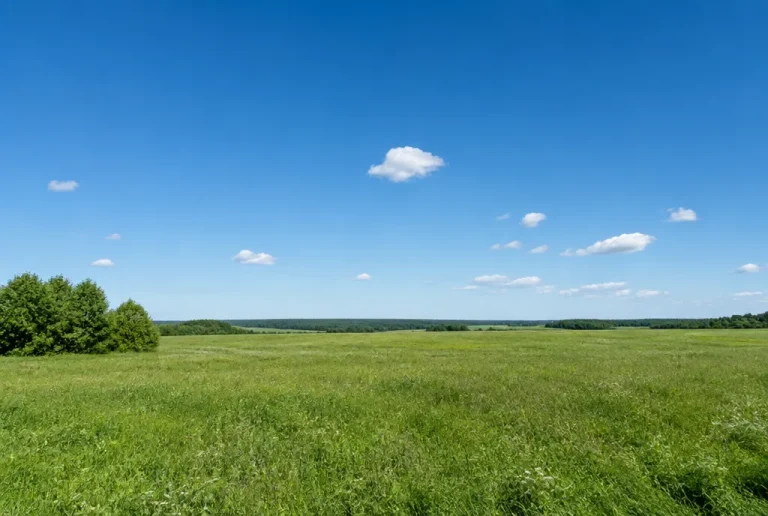
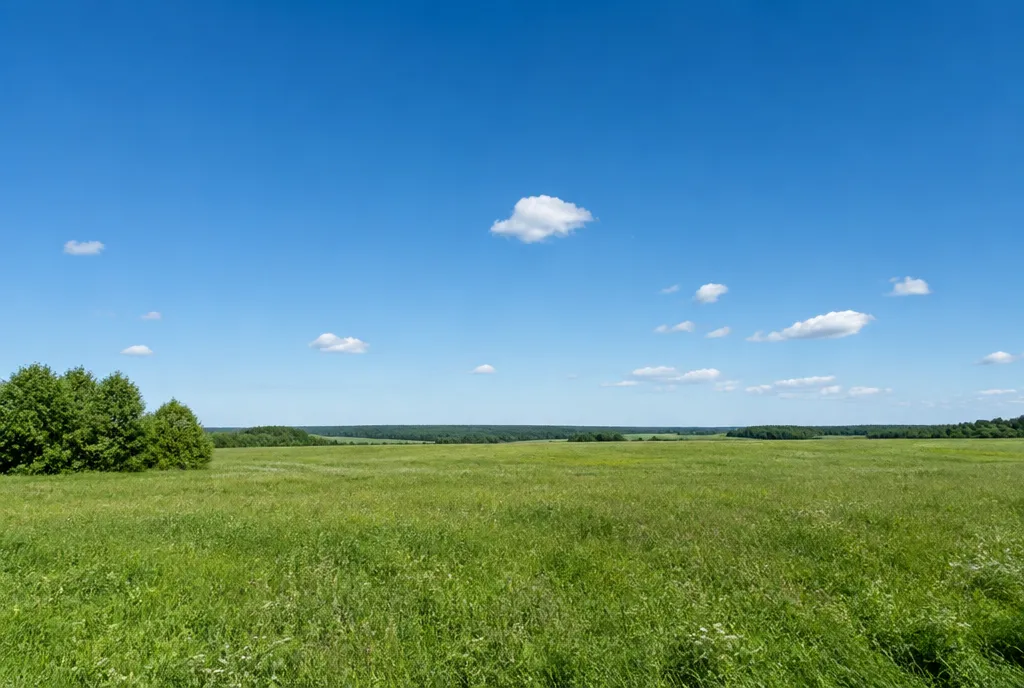
During the day the sun is high, so sunlight takes a fairly short path through the atmosphere to reach you. Along that path, blue light is steadily scattered out of the direct beam and sent across the whole sky. Look anywhere except straight at the sun, and the light arriving from that direction is mostly this scattered blue.
The sun itself looks slightly yellowish-white from the ground because a little of its blue has been removed. Astronauts on the International Space Station see a different picture: in outer space, above the atmosphere, the sun appears white and the sky around it is black, since there is no air to scatter anything. The same is true on the Moon. At night the sky turns dark for the same reason: with no direct sunlight passing through the air, there is almost nothing to scatter.
You may also notice that the sky is deepest blue straight overhead and paler, almost white, near the horizon. Light coming from low in the sky has passed through much more air. According to the National Weather Service, light from the horizon travels through as much as 38 times as much air as light from straight up. Along that long path the blue light gets scattered again and again, some of it is lost, and the colors mix back toward white.
Why is the sky blue and not violet?
If shorter wavelengths scatter more, violet (and indigo, next to it in the rainbow) should win. It doesn’t, for three reasons that work together.
- The sun emits less violet. Sunlight is brightest in the blue-green part of the spectrum and fades toward violet. There is simply less violet light to scatter.
- Some violet never reaches the ground. Part of the shortest-wavelength light is absorbed high in the atmosphere.
- Our eyes are tuned to blue. Human color vision uses three types of cone cells, most sensitive to long (reddish), medium (greenish), and short (bluish) wavelengths. None of them responds strongly to violet. The scattered skylight excites the short-wavelength cones most, with some response from the others, and the brain reads that combination as a pale blue.
So the sky does contain violet light. We just don’t register it as violet. A bee or another animal with different color vision would experience the sky in its own way.
What is the real color of the sky?
There is no single “true” color. Skylight is a mix of different wavelengths, with far more blue and violet than direct sunlight has, and less red. Measured with an instrument, its spectrum peaks toward the short-wavelength end. To human eyes, that mix looks light blue. So the most honest answer is that the sky is mostly blue light with some violet in it, and we perceive it as blue.
Why are sunsets red and orange?
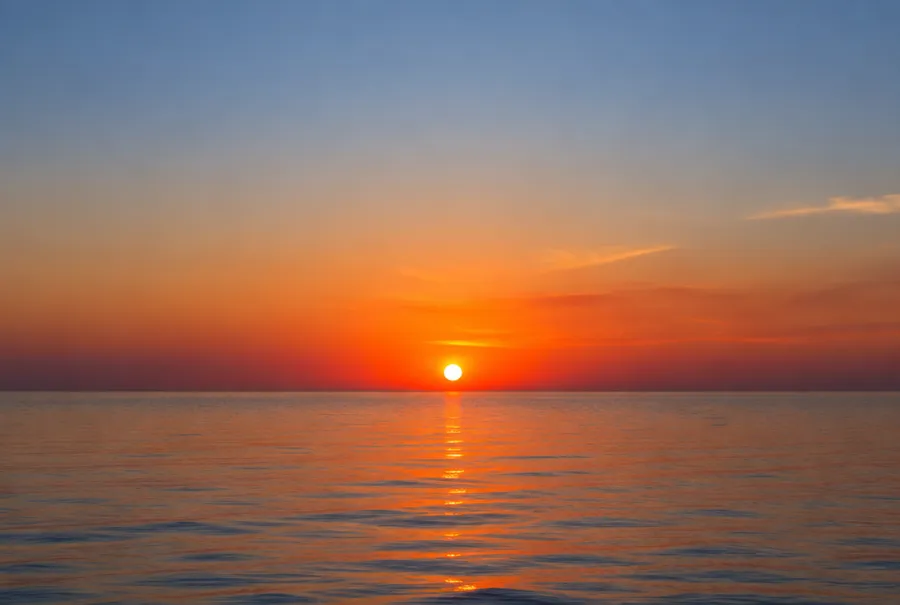
As the sun sets, it sits near the horizon, and its light must pass through a very long stretch of atmosphere before reaching you. Along the way, almost all of the blue and much of the green is scattered out of the beam. What survives the trip is mostly red, orange, and yellow light, which is why the sun and the clouds near it glow in warm colors.
The blue light has not disappeared. It has been scattered sideways and helps illuminate the sky for people farther along, where it is still daytime.
Dust, smoke, sea salt, and volcanic particles in the air can make sunsets more intense. After large wildfires or volcanic eruptions, sunsets around the world can turn unusually deep red or purple for weeks or months. Very clean air, on the other hand, tends to give gentler yellow and orange tones.
Why are clouds white?
Clouds are made of water droplets and ice crystals. These are much larger than air molecules, similar to or bigger than the wavelength of visible light. Particles of that size don’t prefer blue. They scatter all colors about equally, a process called Mie scattering.
When all colors are scattered together, the result looks white. That is also why haze, fog, and the air over polluted cities make the sky look milky or grayish instead of deep blue: larger particles wash out the color. A deep blue sky usually means clean, dry air.
Thick clouds look gray or dark from below because so much light is scattered back up toward space and absorbed along the way that little passes through the bottom. The droplets are still white; they are just in their own shadow.
Is the sky blue because it reflects the ocean?
No. This is a common myth. The sky is blue over deserts, mountains, and cities far from any sea. It works the other way round: the ocean often looks blue partly because it reflects the sky. Deep, clear water also absorbs red light more than blue, which adds to its blue color. If you’re curious about what makes seawater different from lake water, see our article on why the ocean is salty.
What color is the sky on Mars?
Mars has a very thin atmosphere, mostly carbon dioxide, and it is full of fine reddish dust. Photos from NASA landers and rovers show a daytime sky that is butterscotch or pinkish tan rather than blue. The dust contains iron oxides, which absorb blue light and scatter the warmer colors around the sky.
Martian sunsets flip the pattern. Near the sun at dusk, the sky turns bluish. The fine dust particles scatter blue light forward, close to the direction the light is traveling, so the area around the setting sun glows blue while the rest of the sky stays reddish. NASA’s Curiosity rover photographed this blue sunset in Gale Crater in 2015.
The comparison is a good reminder that sky color depends on two things: what the atmosphere is made of and what is floating in it.
Why is the sky blue? An explanation for kids
If you are explaining this to a child, a short version works well:
- Sunlight looks white, but it is really all the colors of the rainbow mixed together.
- The air is full of tiny bits called molecules, much too small to see.
- When sunlight hits them, blue light gets bounced around the most, like a ball pinging off lots of little bumpers.
- That bounced blue light comes at us from all over the sky, so the sky looks blue.
- At sunset, the light has to travel much farther through the air, so most of the blue gets bounced away before it reaches us. The red and orange light is what’s left.
A simple home experiment helps. Shine a flashlight through a clear glass of water with a few drops of milk stirred in. Looking from the side, the water looks faintly blue. Looking through the glass toward the flashlight, the light looks yellow or orange, like a small sunset. The milk particles are larger than air molecules, so the effect is weaker, but the idea is the same. Testing an idea like this is a small version of the scientific method in action.
Summary
The sky is blue because air molecules scatter short-wavelength light much more than long-wavelength light, a process called Rayleigh scattering. Violet scatters even more, but the sun gives off less of it and our eyes are far less sensitive to it, so we see blue. At sunset, light travels through so much air that the blue is scattered away and reds and oranges remain. Clouds look white because their larger droplets scatter all colors equally, and on Mars, fine dust turns the daytime sky tan and the sunset blue.