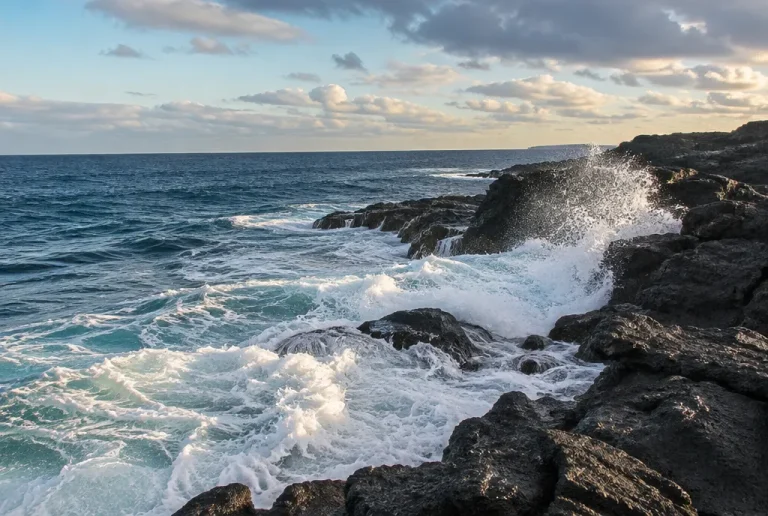
The ocean is salty because rain slowly dissolves minerals out of rocks on land, and rivers carry those dissolved salts to the sea. When seawater evaporates, the water leaves but the salts stay behind. Over millions of years, this has built up to an average salinity of about 35 grams of salt in every kilogram of seawater, or roughly 3.5 percent by weight.
A second source is on the seafloor itself: hot springs called hydrothermal vents, along with undersea volcanoes, release dissolved minerals directly into the ocean. Most of the salt is ordinary sodium chloride, the same compound as table salt.
Where the salt comes from: rocks, rain, and rivers
Rainwater is not perfectly pure. As it falls, it picks up a little carbon dioxide from the air and becomes very slightly acidic. When that rain lands on rocks and soil, it slowly breaks them down, a process geologists call chemical weathering. Water-soluble minerals in the rock release charged particles, called ions, like sodium, calcium, and potassium, into the water.
Streams and rivers collect this water and carry the dissolved ions downhill to the sea. River water still tastes fresh because the amount of dissolved material is small. The ocean is different because it is the end of the line. Water leaves the ocean mainly by evaporation, and evaporation takes only pure water. The salts are left behind, and over geologic time they have accumulated.
The amounts are huge. Rivers deliver roughly 4 billion tons of dissolved minerals and other material to the oceans every year. The U.S. Geological Survey estimates that if all the salt in the sea were spread evenly over Earth’s land surface, it would form a layer more than 500 feet (about 166 meters) thick.
Hydrothermal vents and undersea volcanoes
Along the mid-ocean ridges, where tectonic plates pull apart, seawater seeps down into cracks in the ocean crust. Deep below, it is heated by hot rock and magma, dissolves minerals from the surrounding rock, and then rises back into the ocean through hydrothermal vents. These vents add some ions to seawater and remove others.
Undersea volcanic eruptions also release material, and volcanic gases add chlorine and sulfur compounds. Chloride, the most abundant ion in seawater, is thought to come largely from these volcanic and deep-Earth sources rather than from river water, which is much richer in calcium and bicarbonate than the sea is.
What is actually in seawater?
When scientists say the ocean is salty, they mean more than table salt. Seawater contains a mix of dissolved ions. Sodium and chloride together make up over 90 percent of them, which is why seawater tastes like table salt.
| Ion | Share of dissolved salts (by weight) |
|---|---|
| Chloride | about 55% |
| Sodium | about 30.6% |
| Sulfate | about 7.7% |
| Magnesium | about 3.7% |
| Calcium | about 1.2% |
| Potassium | about 1.1% |
| Everything else | about 0.7% |
A notable feature of seawater is the rule of constant proportions. Whether a sample is a little saltier or a little fresher, these ions appear in almost exactly the same ratios all over the world’s oceans. This is because the ocean mixes thoroughly over thousands of years, while the major salts stay in the water for far longer.
Average salinity of the ocean
Average ocean salinity is about 35 parts per thousand, often written as 35 ‰ or 35 on the practical salinity scale. In everyday terms, a liter of seawater holds roughly 35 to 36 grams of salt, about two level tablespoons. Most of the open ocean falls between about 33 and 37.
Salinity is higher where evaporation is strong and rainfall is low, as in the subtropical Atlantic. It is lower near the equator, where heavy rain dilutes the surface, near the mouths of big rivers, and in polar regions where ice melts. When sea ice forms, it pushes most of the salt out, leaving the water beneath it saltier and denser. This salty, cold water sinks and helps drive deep ocean currents.
Why is the ocean so salty, but not lakes?
Most lakes and rivers are fresh because water flows through them. A typical lake is fed by rivers and drained by at least one outflowing river. Dissolved salts come in, but they also flow out, so they never build up to high levels.
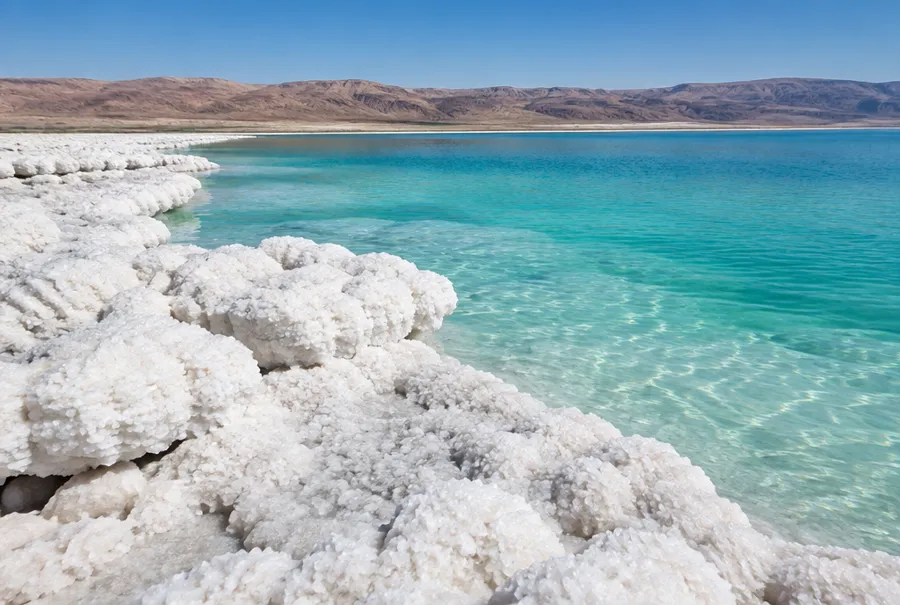
The ocean has no outlet. Water only leaves by evaporation, so the salt stays. Some lakes share that situation. Lakes in closed basins with no river flowing out, known as terminal lakes, lose water only by evaporation. Over thousands of years they become salty too. The Great Salt Lake in Utah is the best-known example in the United States: four rivers feed it, nothing drains it, and its salinity can be several times that of seawater, depending on the arm of the lake and the water level.
So the difference is not about how old the water is or how big the basin is. It is about whether the water has a way out.
Why doesn’t the ocean keep getting saltier?
If rivers keep adding salt, you might expect the ocean to grow saltier every year. Evidence from ancient ocean sediments suggests it hasn’t changed much over very long spans of Earth’s history. The ocean is in what scientists call a steady state: salt goes in at about the same rate it comes out.
Salt leaves seawater in several ways:
- Evaporite deposits. In shallow, enclosed seas and coastal basins, seawater evaporates and leaves thick layers of rock salt and gypsum. Many of the salt mines people use today are old seabeds formed this way.
- Seafloor sediments. Salty water is trapped between grains of mud and sand as sediments pile up on the ocean floor.
- Subduction. Where one tectonic plate dives under another, those salty sediments are carried down into Earth’s interior.
- Chemical reactions. Hydrothermal systems and marine organisms pull certain ions, such as magnesium and calcium, out of the water. Corals, shellfish, and plankton build shells and skeletons from calcium carbonate.
The balance is slow. A sodium atom delivered by a river stays in the ocean, on average, for tens of millions of years before it is removed. Chloride stays even longer. That long residence time is why seawater has had time to become so evenly mixed and so consistently salty.
The saltiest seas and waters on Earth
Among true seas connected to the world ocean, the Red Sea is one of the saltiest, with salinity reaching around 40 to 41 parts per thousand in places. It lies in a hot, dry region with high evaporation, little rain, and almost no rivers flowing in. The eastern Mediterranean and the Persian Gulf are also saltier than the open ocean.
The Dead Sea, despite its name, is not a sea. It is a terminal lake on the border of Israel, the West Bank, and Jordan, and its water is around 30 to 34 percent salt, roughly nine to ten times saltier than the ocean. The water is so dense that people float easily. Even saltier bodies of water exist, such as Lake Assal in Djibouti and Don Juan Pond in Antarctica, both of which are also lakes, not seas.
At the other end, the Baltic Sea is brackish, with low salinity in many areas, because many rivers pour fresh water into it and it exchanges water with the open ocean only through narrow straits.
Can you drink ocean water, even if boiled?
No, and doing so is dangerous. Human kidneys can only make urine that is less salty than seawater. To get rid of the extra salt from a glass of seawater, your body has to flush out more water than you drank. The result is faster dehydration, not relief from thirst.
Boiling seawater does not help either. Boiling kills germs, but the salt stays in the pot and actually becomes more concentrated as water evaporates. To make ocean water drinkable, you have to separate the water from the salt.
That is why sailors and castaways have always needed fresh water. Today, coastal cities and ships use desalination, most often reverse osmosis, which pushes seawater through membranes that hold back the salt, or distillation, which evaporates the water and collects and condenses the steam, much like the natural water cycle.
Why this matters beyond the beach
Ocean salinity is not just a curiosity. Differences in salt content and temperature make seawater more or less dense, and those density differences help drive the global ocean circulation that moves heat around the planet. Scientists track salinity with ships, floating robotic buoys, and satellites. For a closer look at how researchers turn questions like this into testable ideas, see our guide to the steps of the scientific method. And if you have wondered why the ocean often looks blue, the answer is closely tied to why the sky is blue.
For more detail on the sources of sea salt, the NOAA Ocean Service has a short explainer.
Summary
The ocean is salty because rain dissolves minerals from rocks, rivers carry them to the sea, and evaporation removes water but leaves the salts behind. Hydrothermal vents and undersea volcanoes add more. Average salinity is about 35 grams per kilogram, mostly chloride and sodium. Lakes with an outflow stay fresh, while closed-basin lakes like the Great Salt Lake and the Dead Sea turn salty. The ocean does not keep getting saltier because salt is removed at about the same rate it is added, through evaporite deposits, sediments, and subduction. And no, you cannot safely drink it.