
The scientific method is a step-by-step way of answering questions about the world by testing ideas against evidence. The usual steps are: make an observation, ask a question, do background research, form a hypothesis, make a prediction, test it with an experiment, analyze the data, draw a conclusion, and share the results so others can check them.
In short, the scientific method means you do not just guess or trust an authority. You come up with an explanation, figure out what should happen if it is true, and then look to see whether it does. Below, each step is explained with one everyday example that runs through the whole article, followed by the ideas that often cause confusion: hypothesis vs theory vs law, variables and controls, and why the process is really a cycle.
What is the scientific method?
A simple definition: the scientific method is a process scientists use to investigate questions about the natural world through observation, testable explanations, experimentation, and careful analysis of evidence. The goal of the scientific method is to reduce the chance that we fool ourselves, so that scientific knowledge rests on data rather than on hope or habit.
There is no single official list, and it is not a fixed sequence of steps. It is better described as a set of general principles. But the core logic is always the same: a hypothesis must be testable, it must make a prediction that could turn out to be wrong, and then it must be tested. The philosopher Karl Popper called this property falsifiability and argued that it is what separates science from non-science.
How many steps are in the scientific method?
It depends on the textbook. Some list five steps, others six steps or seven steps. The versions differ mainly in how finely they split the process, not in what they say:
- 5 steps: make an observation, ask a question, form a hypothesis, test the hypothesis with an experiment, and draw conclusions.
- 6 steps: the same, with background research added after the question.
- 7 steps: the six above plus a final step to communicate your results.
The 7 steps of the scientific method are the version many US middle schools teach. Below we use nine steps, because separating the prediction and the data analysis makes each part easier to understand.
The steps of the scientific method
To make the steps concrete, we will follow one everyday problem from start to finish: some of the houseplants on your windowsill are wilting while others look healthy.
1. Make an observation
The first step of the scientific method is noticing something. The scientific method starts with curiosity. An observation is information you gather with your senses or with instruments.
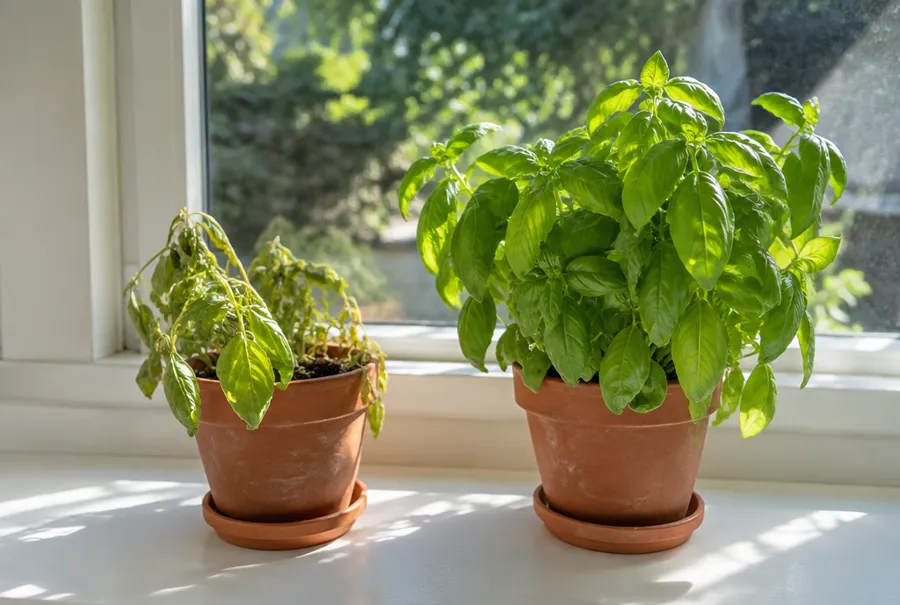
Example: You notice that the two basil plants on the left side of the kitchen window are drooping and yellowing. The two on the right side look green and healthy. All four were bought at the same time from the same store.
2. Ask a question
Turn the observation into a clear, specific scientific question you can actually investigate, an attempt to answer one thing at a time. Good scientific questions usually ask what, how, or why something happens, and they can be answered with measurements.
Example: Why are the left-side plants wilting while the right-side plants are healthy?
3. Do background research
Before you test anything, find out what is already known. This saves time and helps you form a better guess. Scientists read published studies. At home, you might check a reliable gardening guide or ask an expert.
Example: You learn that basil likes six or more hours of sunlight a day, moist but not soggy soil, and warm temperatures. You also realize that the left side of the window gets less direct sun because a tree outside blocks it in the afternoon.
4. Form a hypothesis
A hypothesis is a proposed, testable explanation. It is often called an educated guess, but a good hypothesis is more than that: it is based on what you already know after you have conducted background research, and it must be possible to disprove it. Many people write it as an if-then statement.
Example: The left-side plants are wilting because they get less sunlight than the right-side plants.
5. Make a prediction
A prediction spells out what you should observe if your hypothesis is correct. It links the idea to a measurable result. Students often mix up the hypothesis and prediction: the hypothesis is the explanation, the prediction is the specific outcome you expect if that explanation is right.
Example: If the left-side plants are wilting because of low light, then moving them to the sunny right side should make them recover within two weeks, while plants moved into the shade should start to decline.
6. Test the hypothesis with an experiment
Now you test your hypothesis. Design a fair test that changes one thing and keeps everything else the same, then collect data carefully. This is where variables and controls come in, which we explain in more detail below. Not every test is an experiment in a laboratory. Astronomers and geologists often test a hypothesis by making new observations instead.
Example: You buy four new basil plants of the same variety and size. Two go in the sunny spot, two in the shaded spot. All four get the same pot, the same soil, and the same amount of water at the same time each day. You measure the height of each plant and count yellow leaves every two days for three weeks, and you write everything down.
7. Analyze the data
Analyze your data carefully and honestly. Organize the data collected in a table or graph and look for patterns. Ask whether the difference is large and consistent enough to take seriously, or whether it could be chance. Professional researchers use statistical analysis to check whether the results are statistically significant, meaning unlikely to be a fluke.
Example: After three weeks, both sunny plants have grown several centimeters and have no yellow leaves. Both shaded plants have barely grown and have several yellow leaves each.
8. Draw a conclusion
Decide whether the data support or refute your hypothesis. A conclusion should also mention limits and open questions. If the hypothesis was not supported, that is not a failure. It is information, and it points you toward a new hypothesis.
Example: The results support the hypothesis that low light caused the wilting. But you only tested four plants, so you cannot be completely sure. You might also wonder whether the shaded spot was cooler, which could be a second factor.
9. Share the results
Science is a group effort, so the last step is to communicate your results. Sharing your method and results lets others check your work, repeat your test, and build on it. Professional scientists publish in peer-reviewed journals. At school, this step might be a poster at a science fair. You might simply tell a friend who grows herbs, who could try the same test on their own windowsill.
Example: You post your notes and photos in a gardening forum. Someone points out that the shaded side of your window is also next to a cold draft, which gives you an idea for a follow-up test.
| Step | What you do | Plant example |
|---|---|---|
| Observation | Notice something | Left-side plants are wilting |
| Question | Ask why or how | Why only those plants? |
| Research | Check what is known | Basil needs lots of sun |
| Hypothesis | Propose a testable explanation | Low light causes the wilting |
| Prediction | State what should happen | Plants in sun will recover |
| Experiment | Run a fair test | Two plants in sun, two in shade, same care |
| Analysis | Look for patterns in data | Sunny plants grew, shaded ones yellowed |
| Conclusion | Support or reject the hypothesis | Light is a likely cause |
| Share | Let others check and repeat | Post results, get feedback |
Variables and controls: making a fair test
Applying the scientific method well depends on one idea above all: a good experiment isolates one cause at a time. To do that, scientists sort the factors involved into three kinds of variables.
- Independent variable: the one thing you deliberately change. In the plant example, it is the amount of sunlight.
- Dependent variable: what you measure to see the effect. Here, plant height and the number of yellow leaves.
- Controlled variables: everything you keep the same so it cannot affect the result. Here, plant variety, pot size, soil, water, and timing.
Many experiments also use a control group, a group that does not receive the change being tested. It gives you a baseline to compare against. In a medicine trial, for example, one group gets the real drug and a control group gets a placebo, a look-alike pill with no active ingredient. If both groups improve equally, the drug probably is not doing the work.
Scientists also try to use large enough samples and, where possible, to assign subjects to groups at random. With only two plants per group, a single sick plant could throw off the whole result. With twenty plants per group, a real effect is much easier to separate from bad luck.
Hypothesis vs theory vs law
These three words are often mixed up, and the everyday meaning of “theory” makes it worse. In daily life, a theory is a hunch. In science, it is close to the opposite.
- Hypothesis: a specific, testable explanation for a limited set of observations. It is the starting point of an investigation and may well be wrong. Example: low light is making my basil wilt.
- Scientific theory: a broad, well-tested explanation of some part of the natural world that ties together many facts, laws, and confirmed hypotheses. The US National Academy of Sciences describes a theory as a well-substantiated explanation. Examples include the theory of evolution, germ theory of disease, and plate tectonics.
- Scientific law: a description, often a mathematical formula, of what always happens under certain conditions. It tells you what happens but not why. Newton’s law of universal gravitation describes how strongly two masses attract each other. Einstein’s theory of general relativity explains why.
A common myth is that a theory becomes a law once it has enough evidence. That does not happen. Theories and laws do different jobs: laws describe patterns, theories explain them. Both can be revised if new evidence demands it.
Why the scientific method is a cycle, not a straight line
School posters often show the steps as a neat staircase from observation to conclusion. In reality, the scientific method is an iterative process that loops back on itself constantly.
- If the data do not support your hypothesis, you revise it or form a new one and test again.
- If the data do support it, the conclusion usually raises new questions. In the plant example, the next question might be whether temperature matters too.
- Unexpected results can send you back to observation, because you may have noticed something nobody expected.
- Other people’s feedback can reveal a flaw in the method, which means redesigning the experiment.
Some of the biggest discoveries came from results that did not match predictions. In 1998, astronomers expected to measure the expansion of the universe slowing down. They found it was speeding up, which led to the idea of dark energy. The method did its job precisely because it allowed a surprise to overturn an expectation.
A short history of the scientific method
The scientific method was not invented by one person. Around the year 1000, the mathematician and scientist Ibn al-Haytham (known in Europe as Alhazen), who worked in Cairo, insisted on testing ideas about light and vision with careful experiments rather than simply accepting ancient authorities. In the early 1600s, Francis Bacon argued that knowledge should be built up from observations, and Galileo Galilei combined experiments with mathematics. Isaac Newton later set out rules for reasoning from evidence, and in the 1800s John Stuart Mill described methods for finding causes.
In the 20th century, Karl Popper stressed that scientists can never prove a hypothesis true, only fail to disprove it. Thomas Kuhn added that science alternates between periods of normal science, when researchers work within an accepted framework, and scientific revolutions, when that framework is replaced. Both ideas shaped how the scientific method is taught in science education today.
Why is the scientific method important?
The scientific method is used to explore questions in every scientific field, from medicine to astronomy. It matters because it gives everyone the same rules for deciding what is likely to be correct. A claim does not win because of who makes it but because the evidence holds up. That is how scientific understanding improves over time: vaccines, weather forecasts, and safer bridges all rely on the same basic process of testing and checking.
Peer review and replication
A single experiment, no matter how careful, is not the end of the story. Two checks make science self-correcting.
Peer review
Before a study is published in a scientific journal, it is usually sent to other experts in the same field. These reviewers look for weak methods, errors in analysis, and conclusions that go beyond the evidence. They can ask for changes or recommend rejection. Peer review is not perfect, but it filters out many mistakes before they reach the public.
Replication
Replication means repeating a study, ideally by a different team and sometimes several times, to make sure the same result appears. If a finding is real, it should show up again. If it only appeared once, it may have been a fluke.
Replication matters more than many people realize. In 2015, a large project called the Reproducibility Project: Psychology tried to repeat 100 published psychology studies. While 97 percent of the original studies had reported statistically significant results, only about 36 percent of the repeat attempts did. The project did not prove that the original researchers were dishonest, but it showed how easily chance, small samples, and pressure to publish can produce results that do not hold up. Many fields now encourage preregistering studies and sharing data to make replication easier.
“Which of the following is not a step of the scientific method?”
This is a very common quiz question. The answer choices vary, but the item that is not a step is usually one of these:
- Believing something because an authority or a famous person said so
- Changing or ignoring data that do not fit your hypothesis
- Proving a hypothesis true beyond all doubt
- Choosing the conclusion first and then collecting evidence for it
- Relying on personal opinion or a gut feeling instead of testing
The third one trips many students up. In science, evidence can strongly support a hypothesis, but it never proves it with absolute certainty. There is always room for a new observation to change the picture. The real steps, by contrast, are observing, questioning, researching, hypothesizing, predicting, experimenting, analyzing, concluding, and communicating.
Try it yourself
You do not need a lab coat to use the scientific method. You can practice this scientific process with almost any everyday question. Does a paper towel brand really absorb more water? Does bread go moldy faster in a plastic bag or a paper bag? Which household objects stick to a magnet, and why? Our guide on how magnets work includes several simple experiments you can run with this exact process. And if you want to see how scientists moved from a simple observation to a full explanation, our article on why the sky is blue is a good example.
Summary
- The scientific method is a way of answering questions by testing ideas against evidence.
- The main steps are observation, question, background research, hypothesis, prediction, experiment, analysis, conclusion, and sharing results.
- A fair test changes one independent variable, measures a dependent variable, and keeps other variables controlled, often with a control group.
- A hypothesis is a testable idea, a theory is a broad and well-supported explanation, and a law describes a pattern without explaining it.
- The process is a cycle: conclusions lead to new questions and revised hypotheses.
- Peer review and replication let the wider scientific community catch mistakes and confirm real findings.