
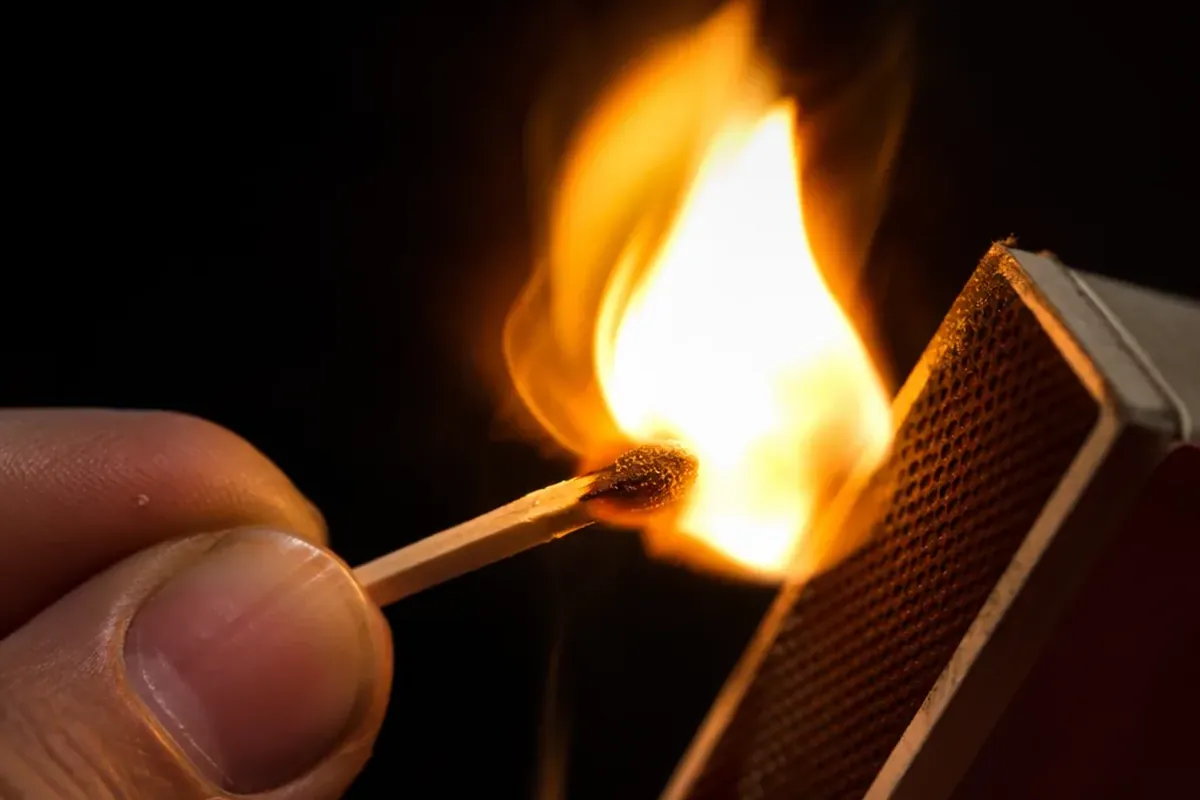
Activation energy is the minimum energy colliding particles need before a chemical reaction can happen. Propane can remain in a canister at room temperature without spontaneously combusting, while striking a match provides friction-generated heat that overcomes the activation barrier. Reactants must first clear this energy hurdle before a reaction can proceed.
Activation Energy in a Chemical Reaction: The Energy Needed to Start
In chemistry, activation energy, written as Ea, is the energy difference between the reactants and the transition state (activated complex). The transition state is an unstable, high-energy species that sits at the peak of the energy curve. Ea is reported in joules per mole (J/mol) or kilojoules per mole (kJ/mol).
Even an exothermic reaction that releases energy overall requires an initial push to overcome the activation barrier. Striking a match produces friction-generated heat that helps start combustion. Once an exothermic combustion reaction is underway, released heat helps neighboring fuel molecules overcome the barrier as well.
Many organic reactions have activation energies from 40 to 150 kJ/mol. An activation energy of 50 kJ/mol reduces the reaction rate by a factor of 108 compared with a reaction that has no barrier.
Collision Theory Explains Why Some Collisions Matter
Collision theory states that reactant particles must collide with sufficient energy (equal to or greater than Ea) and in the correct orientation for a reaction to occur. A collision can have sufficient energy but still fail if improper orientation prevents bond formation.
- Collision frequency: the reaction rate is proportional to how often reactant particles collide.
- Energy: particles need at least the minimum energy (Ea) required for reaction.
- Orientation: reactant particles must collide with the correct orientation.
A mixture of hydrogen gas and oxygen gas can coexist quietly at room temperature without reacting, despite being explosive, because the activation barrier prevents reaction. When Ea is much larger than the average kinetic energy of the molecules, only a few fast-moving molecules have enough energy, so the process is slow.
Read the Hump on an Energy Profile Diagram
On an energy profile diagram, energy is plotted against reaction coordinate. From the reactants, the curve rises to a hump representing the transition state; the vertical distance from the reactant energy level to that peak is the activation energy.
| What the diagram shows | What it means |
|---|---|
| Reactant level | The energy of the starting substances. |
| Peak of the curve | The unstable transition state, or activated complex. |
| Height from reactants to peak | The activation energy for the forward reaction. |
| Products relative to reactants | The overall enthalpy change, ΔH. |
| Lower catalyzed hump | An alternative mechanism with lower Ea. |
In an exothermic reaction, products have lower energy than reactants and ΔH is negative. In an endothermic reaction, products have higher energy than reactants and ΔH is positive. On either forward path, an activation barrier remains.
Temperature Changes the Fraction That Can React
At a higher temperature, the Maxwell-Boltzmann distribution shifts so that a much larger fraction of molecules has kinetic energy equal to or greater than Ea, increasing the rate constant.
For many common reactions, a 10°C increase approximately doubles the reaction rate. Between 300 K and 310 K, average kinetic energy in a gas rises by only about 4%, yet the rate can double because the high-energy fraction of molecules increases. Below 15 kJ/mol, reactions are fast and relatively insensitive to temperature; above 120 kJ/mol, they are slow and much more temperature-sensitive.
The Arrhenius equation puts the pattern into numbers
The Arrhenius equation is k = A e(-Ea/RT). In that expression, k is the rate constant, A is the frequency factor, R is the gas constant (8.314 J/mol·K), and T is temperature in Kelvin. The exponential term represents the fraction of collisions with energy equal to or greater than Ea, while A reflects how well conditions favor properly oriented collisions. On a graph of ln k against 1/T, a straight line has slope -Ea/R, allowing activation energy to be determined graphically.
How Catalysts and Enzymes Lower Activation Energy
A catalyst accelerates a reaction by providing an alternative reaction mechanism with a lower activation energy, and it is regenerated unchanged at the end. The catalyst does not change the overall enthalpy change (ΔH), the free-energy change (ΔG), or the equilibrium constant.
Catalysts are homogeneous when they share a phase with reactants, heterogeneous when they occupy a different phase, or biological (enzymes). In automobile catalytic converters, platinum, palladium, and rhodium lower the activation energy for complete combustion of exhaust gases. For the isomerization of cis-2-butene to trans-2-butene, iodine lowers Ea from approximately 264 kJ/mol to about 118 kJ/mol.
In biology, enzymes make cellular reactions fast enough
In biology, activation energy is the barrier metabolic reactions must overcome. At an active site, enzymes, which are mostly proteins, bind a substrate and stabilize the transition state, lowering the activation energy so cellular reactions can sustain life at body temperature. In addition to proteins, some RNA molecules (ribozymes) also act as biological catalysts.
The uncatalyzed decomposition of hydrogen peroxide, 2 H2O2 → 2 H2O + O2, is exothermic with ΔH = -196.1 kJ/mol, but requires about 75 kJ/mol of activation energy. In blood and liver, catalase lowers that Ea to below 8 kJ/mol and increases the reaction rate by a factor of 2 × 10¹¹ or more at physiological temperatures.
Forward and Reverse Reactions Do Not Share the Same Hurdle
For an exothermic reaction, products lie lower than reactants on an energy profile. The forward activation energy is therefore smaller than the reverse activation energy, expressed as Ea(forward) = Ea(reverse) + ΔH. Because ΔH is negative, the forward hurdle is smaller.
A catalyst lowers the activation energy for both forward and reverse reactions equally. It speeds the approach to equilibrium, but does not shift the equilibrium position or change ΔH.
Surface Energy and Reaction Types Are Different Questions
Surface energy, also called surface free energy, measures the excess energy at a surface compared with the bulk material resulting from the disruption of intermolecular bonds. It is measured in J/m² or N/m rather than kJ/mol. Metals and inorganic salts typically have surface energies of 1–2 J/m².
Activation energy applies across reaction categories. Most chemical reactions can be classified into one or more of seven basic types:
- Combination (synthesis): A + B → AB.
- Decomposition: AB → A + B.
- Single replacement: A + BC → AC + B.
- Double replacement: AB + CD → AD + CB.
- Acid-base.
- Combustion.
- Oxidation-reduction (redox).
Common Misconceptions About the Energy Barrier
- “Exothermic means it starts by itself.” No. Hydrogen peroxide decomposition releases energy overall, but uncatalyzed decomposition still has an Ea of about 75 kJ/mol.
- “A catalyst adds energy to the reaction.” No. It provides a different mechanism with a lower barrier and is regenerated unchanged.
- “Any energetic collision works.” No. Correct molecular orientation is required as well as sufficient energy.
- “A catalyst changes equilibrium.” No. It lowers Ea in both directions equally and does not change the equilibrium constant.
- “The hump is the overall energy change.” No. The hump measures Ea; the difference between reactants and products is ΔH.
Frequently Asked Questions
What is activation energy in GCSE chemistry?
In GCSE chemistry, activation energy is the minimum amount of energy needed for a reaction to take place: the energy required for successful collisions. On a reaction profile diagram, it is the vertical distance between the energy of the reactants and the top of the hump.
How does activation energy affect reaction rate?
A lower Ea means more particles have enough energy to react at a given temperature, resulting in a faster reaction. A higher Ea means fewer particles have sufficient energy, making the reaction slower and more temperature-sensitive.
How do catalysts and enzymes lower activation energy?
They provide an alternative reaction mechanism with a lower activation energy. Enzymes bind substrates at an active site and stabilize the transition state without altering the reaction’s overall ΔH or equilibrium constant.
What does activation energy mean in biology?
It is the energy barrier that metabolic reactions must overcome. Enzymes lower activation energies so that cellular reactions can proceed quickly enough to sustain life at body temperature.
Can activation energy be negative?
Activation energy is defined as the energy difference between the reactants and the transition state, representing the minimum energy colliding particles must have to undergo a reaction.
What is surface energy?
Surface energy is the excess energy at a surface compared with the bulk material resulting from disrupted intermolecular bonds. It is a distinct physical property measured in J/m² or N/m rather than kJ/mol.