Convection is heat transfer by the bulk movement of a fluid: in liquids and gases, warmer material usually becomes less dense and rises while cooler, denser material sinks. Through that motion, a pot of boiling water becomes a circulating loop, a sea breeze takes shape, and heat travels through Earth’s mantle. The same basic physics explains why a fan can change how an oven cooks.
What convection means in science
In science, the definition of convection is simple: heat is carried along as a liquid or gas moves. From the Latin convehere comes the word, meaning “to carry together.” Unlike heat spreading through a motionless object, convection moves the material that holds thermal energy.
Among the three major ways heat moves, conduction passes energy through direct molecular contact; radiation travels as electromagnetic waves and needs no medium. By contrast, convection needs a fluid, which in physics means a substance that can flow, such as water or air.
To describe the rate of convective heat transfer, engineers often use Newton’s law of cooling: q = h · A · ΔT. In that expression, h is the convective heat-transfer coefficient, A is surface area, and ΔT is the temperature difference. A larger exposed area or a bigger temperature difference can therefore increase the transfer.
How a convection current carries heat upward and back down
When part of a fluid is warmer than the fluid around it, natural convection begins. When heated, most fluids expand, so the warmer portion becomes less dense. Under gravity, the lighter portion rises and cooler, denser material takes its place.
- A heat source warms the fluid near it.
- After warming, the fluid expands, becomes less dense, and rises.
- Farther from the source, it cools and becomes denser.
- As density increases, the fluid sinks, completing a convection current.
Within a convection cell, that loop includes a rising plume, sideways movement near the top, a descending column, and return flow near the bottom. For the pattern to continue, a heat source and a heat sink must contact the fluid. From 4 °C to 100 °C, water behaves normally in this respect; below 4 °C it is unusual because it expands as it freezes.
For this kind of motion, gravity is essential. In free-fall environments such as the orbiting International Space Station, natural convection cannot occur.
Natural and forced convection solve different problems
With natural convection, temperature differences and buoyancy provide all the driving force. A familiar example is warm exhaust rising in a chimney. By using a fan, pump, or blower, forced convection sets the fluid in motion so its direction and rate can be controlled.
| Type | What moves the fluid | Example |
|---|---|---|
| Natural convection | Density differences and gravity | Air rising from a room heater |
| Forced convection | A fan, pump, or blower | Air pushed through car-radiator fins |
By moving more fluid past a heat source in the same time, forced convection carries more heat away than natural convection. For free convection in air, h is typically 2–25 W/(m²·K). In forced air convection, the range is 10–1,000 W/(m²·K), while water can reach 500–10,000 W/(m²·K).
As a practical system, a car radiator is a classic forced-convection system. Through the engine, a pump circulates coolant, and through the radiator fins an axial fan forces air to release heat to the atmosphere. Despite its name, most of the heat removed there is carried away by forced convection, not thermal radiation.
Convection, conduction, and radiation are not interchangeable
Through direct molecular collisions, conduction transfers energy. In a solid, molecules pass energy to neighbors without traveling from their positions. By contrast, convection transports heated material to a new location. Without a fluid or direct contact, radiation can still cross a vacuum.
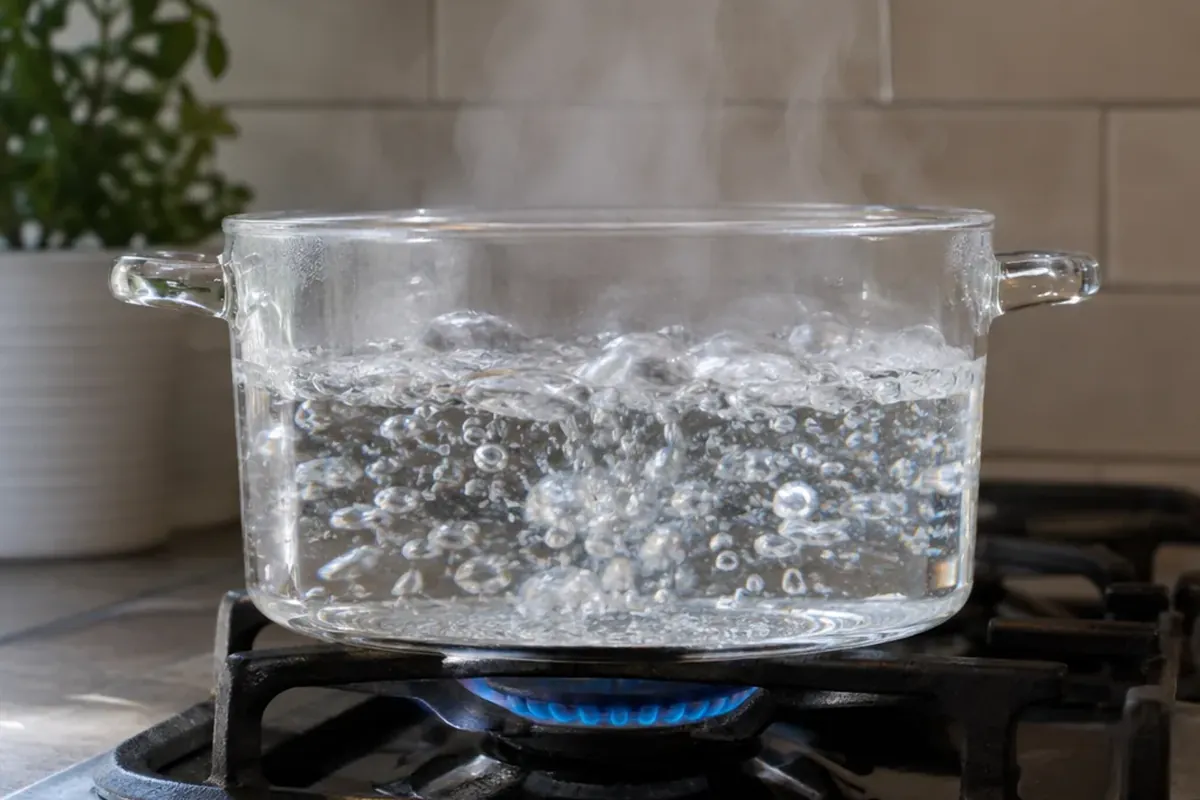
When water boils in a pot, all three mechanisms operate together. Through the metal pot wall, heat conducts into the water. Near the bottom, warmed water rises while cooler water sinks, creating convection. From the burner and steam, radiation also reaches the pot.
Everyday convection examples, from boiling water to cooking
In boiling water, convection is easy to see. Near the bottom of the pot, water is heated through the pot, becomes less dense, rises, cools nearer the surface, and sinks again.
In a heated room, air near a radiator or heater warms and rises toward the ceiling. Near the floor, cooler air sinks and moves toward the heater, forming a natural loop. For forced convection, HVAC systems instead use fans and pumps to distribute warmed or cooled air through a building.
Inside a convection oven, a fan circulates hot air around a dish. By reducing stagnant hot and cold pockets, this can cook food more evenly, up to 25% faster. For a recipe written for a traditional oven, lower the setting by about 25 °F (about 15 °C) and keep the cooking time, or keep the temperature and reduce cooking time by about 25%.
Among other visible examples are a hot-air balloon, where heated air is less dense than surrounding cooler air, and ice melting in a drink. Because it is denser than the surrounding liquid, cold meltwater sinks while warmer liquid rises to contact the ice.
How convection affects the atmosphere, oceans, and Earth
Through solar heating, atmospheric convection helps produce clouds, thunderstorms, and sea breezes. During the day, land warms faster than the sea. Over land, warm air rises, and cooler, denser air from over the sea flows inland. From the coast, a sea breeze commonly extends 1–2 km vertically and 10–100 km horizontally. At night, land cools faster and the direction reverses into a land breeze.
For thunderstorms, moisture, an unstable air mass, and a lifting force are all needed. As warm, moist air rises, cools, and condenses, released latent heat supports further upward convection. In altitude, cumulonimbus clouds can grow from 500 m to 16,000 m (2,000–52,000 ft).
In the oceans, density differences linked to temperature and salinity drive thermohaline circulation. Toward the poles, warm surface water moves; as it cools, it becomes denser, sinks, and forms deep water that flows back toward the equator. Through all ocean basins, a cubic meter of water takes about 1,000 years to complete the global conveyor-belt journey.
Over geological time, convection also occurs in Earth’s solid mantle, which behaves like an extremely viscous fluid. This creeping motion carries interior heat toward the surface and, alongside ridge push and slab pull, is one of three forces involved in tectonic-plate motion. Typically, plates move 2.8–10 cm per year, while underlying mantle flow is about 8 cm per year.
Common misconceptions about convection
“Convection means hot air.”
Although air is one fluid that convects, water and other liquids do too. The defining feature is moving fluid carrying heat, not the particular material.
“Anything warm rises.”
Because heating usually lowers its density relative to surrounding material, warm material rises. That statement depends on buoyancy and gravity; it is not a universal rule in every setting.
“A radiator cools mainly by radiation.”
In a car radiator, fan-driven air flow removes most of the heat by forced convection. Its familiar name does not identify the main mechanism.
“Convection works only in liquids and gases.”
Although Earth’s mantle is solid rock, it can flow extremely slowly over geologic timescales. At centimeters per year rather than meters per second, that slow motion allows mantle convection.
Frequently Asked Questions
What is convection in one word?
In one word: transport. Moving fluid carries heat from one place to another.
How does convection transfer heat?
Away from a heat source, warmer fluid moves and carries thermal energy with it; cooler fluid moves in to replace it.
What is the difference between convection and conduction?
By direct molecular contact, conduction passes energy; through the bulk movement of a liquid or gas, convection transfers heat.
Is boiling water an example of convection?
Yes. In a pot of boiling water, warmer water rises and cooler water sinks, forming a circulating current.
What is convection in cooking?
In cooking, it is heat transfer by moving air or liquid. In an oven with a fan, circulating air helps heat reach food more evenly and can shorten cooking time.
When should you use a convection oven setting?
Use it when even cooking matters. Then adjust the recipe by lowering the setting about 25 °F or by shortening the cooking time about 25%, and check the food as it cooks.